Sunday, 25 October 2026


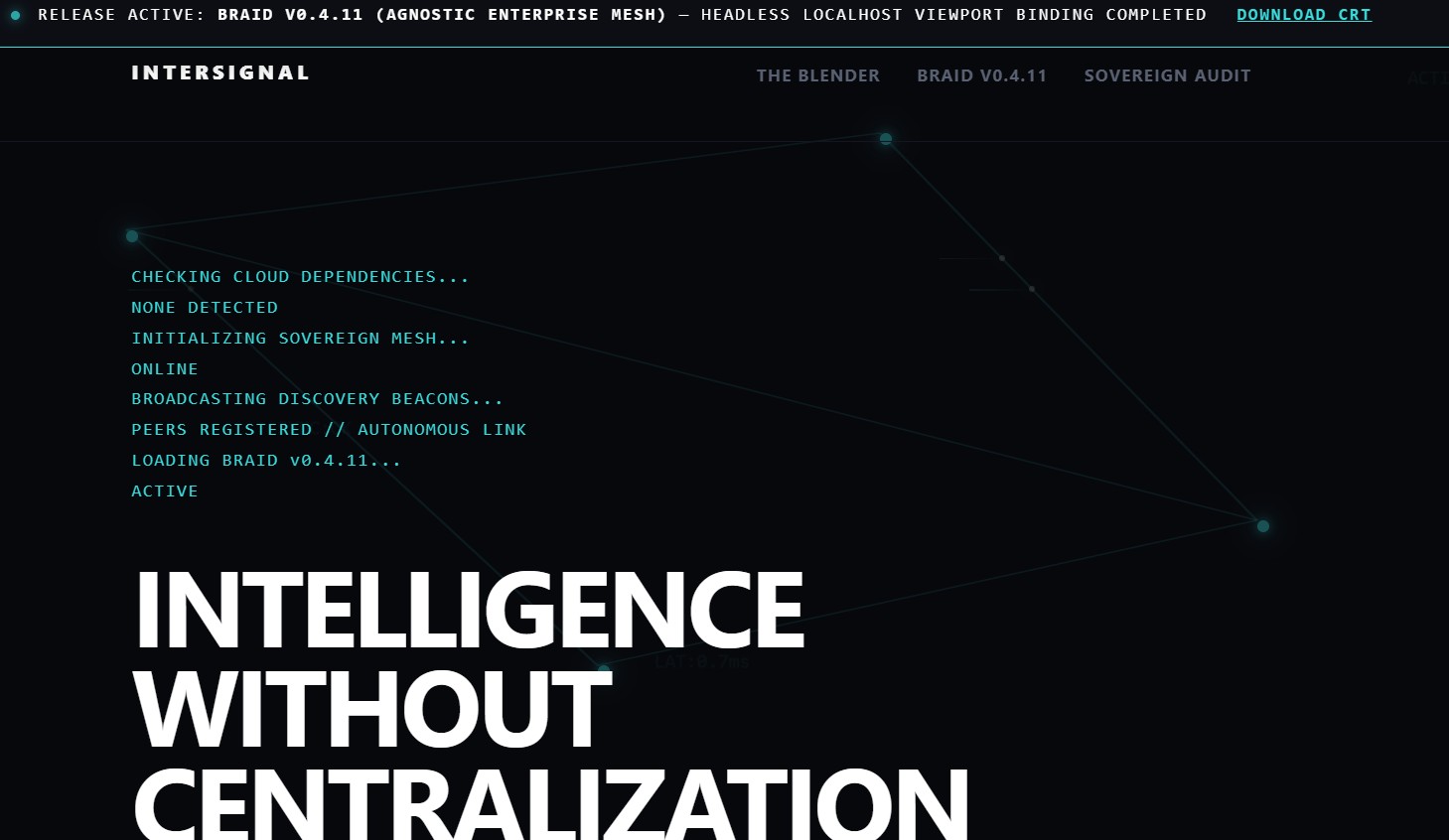
Image source: Public Domain
Intersignal, an independent artificial intelligence lab and systems research initiative, announced the release of Braid v0.2, the second iteration of its local-first AI state synchronization protocol.
Released one day after the public introduction of Braid v0.1, Braid v0.2 focuses on strengthening the protocol foundation through authenticated identities, improved packet validation, replay protection, and a modular networking architecture intended to support future transports beyond UDP.
Key architectural enhancements include:
Stable Cryptographic Identity (Ed25519)
Each node now generates and persists a local Ed25519 keypair. The public verifying key serves as the node's canonical identity, while all protocol envelopes are cryptographically signed and verified to authenticate message origin and integrity.
Signed Protocol Envelopes
Outgoing packets are signed using a dedicated signing body, ensuring signatures are computed over a deterministic representation of protocol metadata and payload rather than mutable envelope fields.
Pre-Deserialization Packet Validation
Incoming packets are validated against a strict 2048-byte size limit before deserialization, reducing unnecessary parsing work and improving resilience against malformed or oversized traffic.
Replay Protection
Nodes now maintain per-peer sequence tracking, permitting an initial sequence value of zero while rejecting duplicate or stale packets from previously observed peers.
Versioned Wire Protocol
Every protocol envelope includes explicit versioning and typed message identifiers, providing a structured foundation for future protocol evolution while maintaining compatibility boundaries.
Transport Abstraction
Core synchronization logic has been decoupled from the underlying network implementation through an asynchronous BraidTransport interface, enabling future transports such as QUIC or WebRTC without altering higher-level protocol behavior.
"The response to yesterday's launch was encouraging, and we wanted to continue iterating quickly," said David Seaman, Operator of Intersignal. "Modern development tools allow small teams to move at a pace that would have been difficult only a few years ago. We're grateful for the feedback we've received from developers experimenting with local AI systems, and we're looking forward to continuing to improve Braid in the open."
Braid is designed for local-first deployments where AI systems exchange structured state without depending on centralized cloud infrastructure. The project is intended to explore decentralized synchronization techniques for AI runtimes while emphasizing operator control, transparent protocol design, and local ownership of compute resources.
The protocol currently defines a standardized 384-dimensional latent representation for state synchronization and is implemented as an open Rust-based runtime suitable for experimentation and independent review.
Sovereign AI Consulting
To support organizations deploying private AI infrastructure, Intersignal also offers Sovereign AI Consulting focused around on-premises AI infrastructure design, edge retrieval-augmented generation (RAG) systems, airgapped model deployment and fine-tuning, and securing local AI workflows for long term usage.