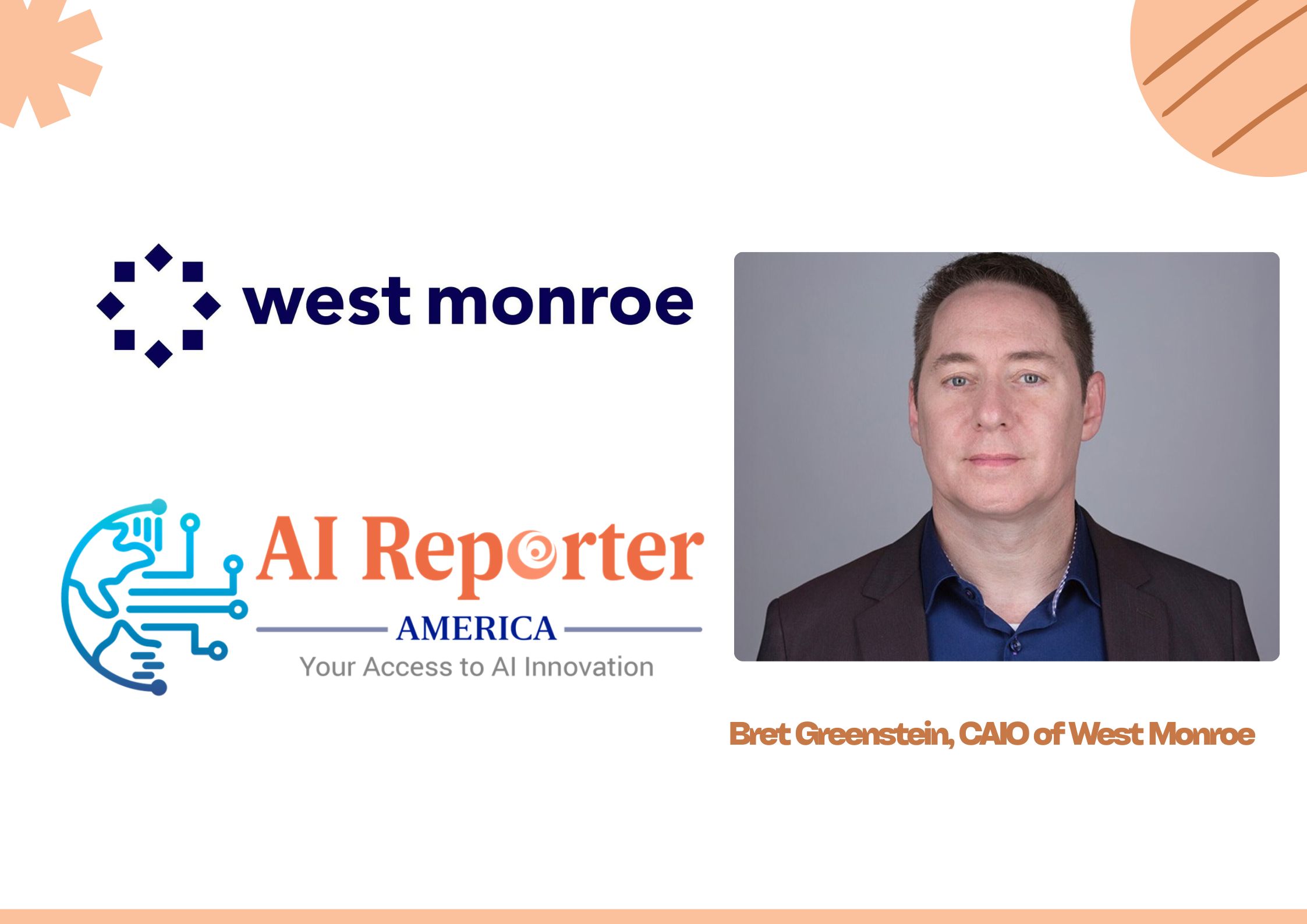
As AI continues to reshape the consulting industry, organizations are looking for faster and more accessible ways to evaluate business opportunities, assess disruption, and build strategic roadmaps. By combining AI with deep consulting expertise, firms are redefining how early-stage strategy is developed while shifting greater emphasis toward execution and measurable outcomes. In an exclusive conversation with AI Reporter America and Bret Greenstein, CAIO of West Monroe discussed how its publicly available AI-powered business strategy agents are helping democratize strategic insights, accelerate decision-making, and advance the firm's vision of becoming an AI-native consulting leader.
1. What inspired West Monroe to make AI-powered business strategy agents publicly available?
The inspiration came from recognizing that AI is rapidly changing the economics of early-stage strategy work. Activities like exploring options, pressure-testing assumptions, identifying risks, and developing an initial point of view can now be done much faster and more effectively with the right AI tools.
That raises an important question: what parts of consulting work should clients still be paying for? At West Monroe, we believe the real value increasingly comes from what happens after that initial insight — helping organizations decide what is worth pursuing and execute against it. WestMonroe.ai reflects that belief by making a portion of that early-stage strategic thinking more broadly accessible.
2. How does WestMonroe.ai change access to strategic insights for business leaders?
WestMonroe.ai significantly reduces two traditional barriers to early-stage strategic thinking: cost and speed.
Historically, getting an initial disruption assessment, growth strategy, or AI roadmap often required engaging a consulting firm and waiting weeks for a first recommendation. With WestMonroe.ai, business leaders can input a question, add company context, and receive a usable first cut on demand.
It democratizes access to strategic insight—showing not just our clients, but everyone, how to explore complex questions, pressure-test assumptions, and focus their time on the harder work ahead.
3. What differentiates these agents from traditional consulting engagements?
These agents are not generic AI tools. They are built on West Monroe’s consulting IP, industry expertise, and real-world experience helping clients solve complex business problems.
Each agent is designed around a specific, high-value business question, from business model risk and growth strategy to talent strategy, AI maturity, use case prioritization, and AI policy. They go beyond broad-brush frameworks or backward-looking benchmarks by compressing data analysis into a more current, personalized assessment of a leader’s specific question.
That said, these agents are a starting point, not a replacement for consulting. They help leaders get to a strong first cut faster, so time with advisors can focus on the harder work that follows: building trust, driving transformation, operationalizing change, and delivering measurable outcomes.
4. How do you balance AI-generated recommendations with human expertise and judgment?
The platform is designed to augment leadership judgment, not replace it.
AI can help leaders analyze scenarios, surface insights, and accelerate early-stage thinking. But deciding what is worth pursuing, shaping a recommendation into a real strategy, and executing that strategy across an organization still requires human judgment, experience, and accountability.
5. How do you see AI agents reshaping the consulting industry in the coming years?
AI is fundamentally changing which parts of consulting clients should have to pay for.
Work that historically required significant time and senior consulting hours — an initial growth strategy, disruption assessment, or workforce scenario — can increasingly be developed faster and more effectively with AI.
That shifts the value proposition of consulting. The front end of early strategy work is becoming more AI-enabled and accessible, while the greatest value increasingly lies in helping organizations operationalize those insights, manage complexity, and drive measurable outcomes through execution.
6. What challenges do organizations face when acting on AI-driven strategic recommendations?
Generating a strong recommendation is becoming easier. Acting on it remains difficult.
AI can make strategic recommendations more relevant by personalizing them to a company’s specific data and business context, which is what WestMonroe.ai does. But organizations still need to align stakeholders around priorities, adapt operating models, and manage the organizational change that follows.
That execution layer is where complexity lives. AI can accelerate insight generation and help leaders get to the hard work faster, but transformation still requires buy-in, disciplined execution, and change management.
7. How does WestMonroe.ai support West Monroe’s long-term vision as an AI-native consulting firm?
WestMonroe.ai is both a proof point and a signal of where we believe the market is heading.
We have been aggressively transforming ourselves to be the most ai-native consulting firm there is. We don’t just advise clients on AI — we use it across our own workflows, delivery, and operations every day. That hands-on experience gives us credibility in helping clients cut through the noise, understand what actually creates business value, and move beyond AI experimentation.
The platform reflects our belief that strategic thinking will become faster, more iterative, and increasingly AI-enabled. At the same time, we remain confident that long-term differentiation in consulting will come from something AI alone cannot provide: deep industry expertise, execution excellence, and the ability to help clients turn ideas into real business outcomes.