Tuesday, 15 September 2026


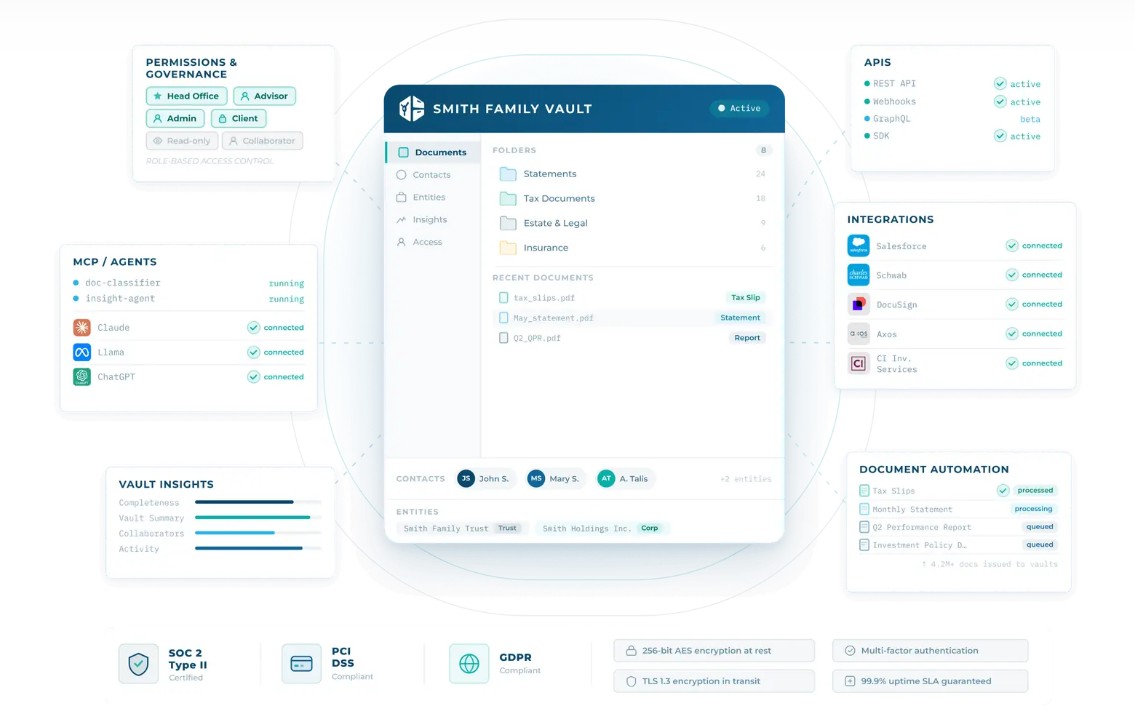
Image source: Public Domain
FutureVault, the category-defining leader in AI-powered Digital Vaults and intelligent document infrastructure for banking, financial services, and insurance (BFSI), today announced the launch of FutureVault AI Agents, which execute multi-step document workflows across the systems a firm already runs on, with governance and human oversight designed into every step.
Most AI in financial services answers questions. FutureVault AI Agents orchestrate end-to-end task and workflow execution. Each agent owns a defined operational mandate, sequences every step, and escalates only what requires human judgment. The launch is FutureVault's third major AI infrastructure release in six months.
Built Against Documented Operational Drag
FutureVault is building its agent library against measured failure points, not generic use cases. Operational assessments of advisory firms surface the same pattern: one client record keyed by hand into seven or more systems, onboarding that runs three weeks, and no exception reporting anywhere, so missing documents are found by searching rather than surfaced.
Beyond client onboarding, agents in deployment or active development include:
FutureVault AI Agents build toward a complete end-to-end orchestration of the document lifecycle versus point automation of isolated tasks.
"Agents are not general-purpose assistants pointed at a firm and left to figure it out," said Petar Vukasinovic, CTO at FutureVault. "Every agent starts from a measured point of drag, a step someone repeats by hand dozens of times a week, and is scoped to eliminate exactly that. Narrow scope is what makes an agent reliable, and reliability is what makes it deployable."
Inside a FutureVault Agent: Client Onboarding
A CRM task update after an advisor meeting triggers the case. The agent retrieves the client record and works a seven-item checklist:
In one workflow case, the agent found the Transfer of Assets template missing from the firm's e-signature system, escalated to the advisor, and flagged the downstream items waiting on it. Rather than failing quietly, it named the gap and remained in queue.
Every Consequential Action Requires Permission
FutureVault AI Agents do not act unilaterally on anything that matters. Before generating the client upload link, the agent issued a permission request naming the action, the folder, the account, and a decision note explaining why, then waited for approval. Every action is logged to the audit trail, and document data never leaves the firm's environment.
Build Your Own Agents
FutureVault AI Agent Builder lets enterprise teams create, name, and provision their own agents. Firms define the mandate, the checklist, the connected systems, and the approval thresholds, then assign each agent to specific advisors, teams, or lines of business.
Every agent firms build inherits the same permission structure, escalation model, and audit trail as every agent FutureVault ships.
Strong Investment in Secure AI Infrastructure
Agents are the third layer in an AI architecture FutureVault has invested in continuously. AI Vault Insights, launched in March, turned the document layer into a continuous intelligence engine. The FutureVault MCP and AI Orchestration Layer followed in April, connecting it securely to the broader AI ecosystem.
Neither works without the layers underneath: a document layer giving AI an audit-ready source of truth, and a governance layer determining what any AI system is permitted to see and do. FutureVault has spent a decade building the optimal foundation for enterprise financial services.
"Insight without action is a report. Action without governance is a liability," said Daniel Kenny, CEO of FutureVault. "Three major releases in six months is where the investment is going. Firms want infrastructure they can connect to anything and still put in front of an examiner."