Sunday, 25 October 2026


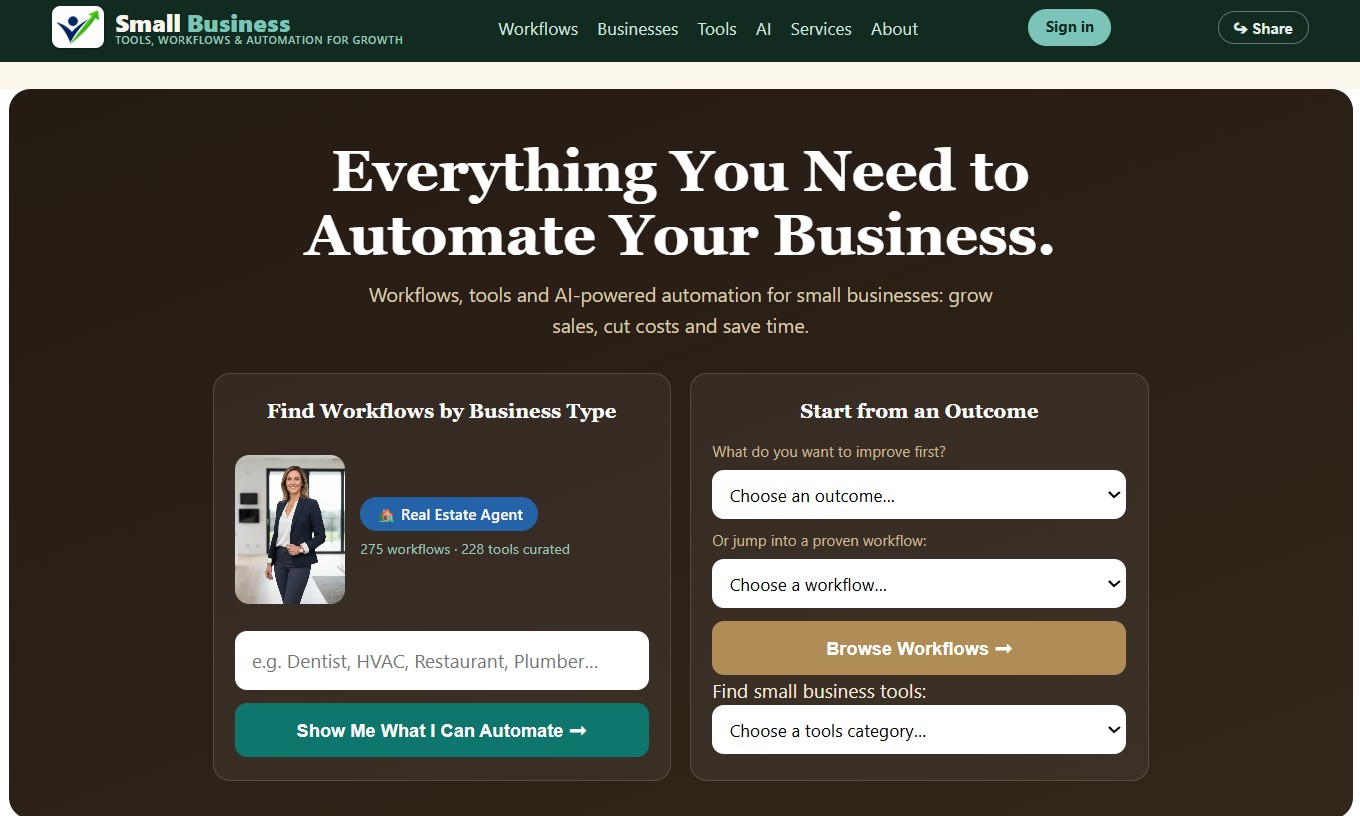
Image source: Public Domain
SmallBiz.ai, launched by Irvine-based CloudIntelligence.ai, is designed to help small businesses use AI and technology to increase sales, reduce repetitive labor and simplify operations, without adding another layer of disconnected software. The platform starts with the business outcome, then uses intelligence from ToolsInfo.com and AICost.ai to identify the most cost-effective combination of existing tools, integrations, open-source components, open-weight models and AI automation that delivers that outcome for the small business, with governance of data, privacy and intellectual property built in from the start.
AI powered workflows for Small Business - automations for sales, marketing, daily operations, accounting, customer relationships, support & more are giving small businesses the critical competitive edge they need in today's economy and even more so for future.
AI adoption for small business automation is becoming an integration problem. Industry research through 2026 tells a consistent story: roughly 80% of small businesses now use AI regularly, but fewer than one in five call it core to operations, and about a third cite lack of integration between their digital tools and systems. Only a small fraction, less than 10% of AI-using workers at small businesses, use it to automate workflows with minimal human involvement.
The question small business owners are left with is the one SmallBiz.ai was built to answer: what should I automate, with what, and how do I make it work safely?
The workflows are live. One of 275+ small business workflows on SmallBiz.ai, Turn Voice Notes Into Job Reports (https://smallbiz.ai/w/post-service-note-automation), turns a spoken post-service note from a nurse, plumber or technician into a structured record routed to its existing systems, modeled to save roughly 20 staff hours a month under its stated assumptions. The same workflow appears in two different SmallBiz.ai Automation Centers, the family clinic (smallbiz.ai/b/family-physician) and the plumber (smallbiz.ai/b/plumber), each mapping its workflows, tools and playbooks. All 275+ small business workflow blueprints and 500+ SmallBiz.ai Automation Centers are free.
The problem is familiar. A customer calls while everyone is on a job; nobody follows up. An estimate goes unchased and an invoice unpaid, while the business pays for a CRM, scheduling, accounting and AI subscriptions that do not work as one system. Small businesses do not need more technology; they need what they already have, and whatever they add next, to work together and produce an outcome they can measure: more sales, lower labor cost, faster service or simpler operations.
It starts by asking what kind of business you run, what you do in it and what you want to accomplish, then works backward, reusing existing software and deploying focused automation only where it pays for itself.
"Small business owners ask us one question: what should I automate that actually moves the business needle?" said Subramanyam Vdaygiri, founder of CloudIntelligence.ai. "Behind it are three more: will it grow sales or protect my margins, will it work with the tools I already run, and is my data safe?"
"So we built the answer: 275+ workflows across 500 small business types, on top of our vast tools knowledge base and the AICost.ai platform. To avoid tool clutter we build just the features a business needs as custom middleware rather than adding another subscription, and use proven open source where it fits, priced to implement and maintain for years, with security and governance built in. The phone gets answered, the lead followed up, the invoice paid."
The whole small business automation knowledge base is free at SmallBiz.ai: the workflows, nearly 5,000 tools guides, checklists and comparisons, the tools integrations and the AvatarVA semantic chatbot that answers whatever an owner asks. SmallBiz.ai is a destination for every small business interested in implementing AI powered automations.
Living up to its name, SmallBiz.ai makes AI a core automation pillar: integrations now deploy quickly and with fewer resources than ever, and as AI prices fall it is helping small businesses get more customers, convert and keep them, save owner and staff time, improve cash flow, get paid faster, cut costs and labor, run the business better and reduce risk. Backed by AICost.ai, implementations stay affordable across the range: a simple step that turns a voicemail into a written message and a follow-up task, a RAG support assistant answering customers questions from the business's own documents, or agentic automations running daily operations.
SmallBiz.ai draws on 67,000+ tools, 275+ mapped workflows, nearly 2,800 role guides, 500+ small business types and 88 curated free and open-source alternatives, with AICost.ai's 120+ cost and governance decision engines evaluating economics, scaling, model choices and governance constraints. Each business type gets its own Automation Center, a living page with its workflows, top tools, playbooks and guides: a solo attorney starts at smallbiz.ai/b/solo-practice-attorney, with all 500 at smallbiz.ai/workflows.
Because the platform is built by practitioners for owners, engagement starts small and stays affordable: a $49 one-hour Automation Consult (credited toward any implementation), a $299 AI Business Blueprint that delivers a written plan with ranked opportunities and a 90-day roadmap, and a $29 per month Automation Advisor retainer. Workflow implementations are quoted after the consult, scoped to business size.
"The next wave of technology decisions will not be made only by people," said Hanvish Vdaygiri, data scientist and AI engineer at CloudIntelligence.ai. "AI agents will increasingly select and connect tools on a business's behalf. That requires machine-readable intelligence linking business outcomes to workflows and tool capabilities, then applying cost, privacy, security and governance constraints. We are building those connected intelligence layers across ToolsInfo.com and AICost.ai, with SmallBiz.ai applying them to the needs of small businesses."
SmallBiz.ai is built on the CloudIntelligence.ai core intelligence platform of ToolsInfo.com (technology and role intelligence), AICost.ai (AI cost, policy and governance decision intelligence) and AvatarVA.com (semantic engine), with vertical applications for healthcare, legal and managed service providers.
Start free at https://smallbiz.ai. Partnership, strategic and corporate inquiries: mailto:partner@cloudintelligence.ai.
Additional Platform and Methodology Background
Five Ways SmallBiz.ai Is Different
The Problem: Work Falls Between the Tools
A company may own every capability it needs and still lose a customer because nothing connects lead, response, qualification, CRM, appointment, estimate and payment.
Independent surveys through 2026 put full integration of AI into core operations at roughly one in seven small businesses, while transaction data shows only about one in eight paying for a dedicated AI tool, and the large majority of those who did keep paying year over year.
And the highest-value automation is often the least glamorous. Industry payment research in 2026 found roughly six in ten small businesses carrying invoices overdue by at least 30 days and nearly half reporting that payment-processing times create cash-flow gaps even after customers pay. Manual processes are the leading cause of delayed payments, and the research associates faster follow-up and automation with fewer overdue invoices.
An automated lead to quote to invoice to reminder to payment to bookkeeping workflow is often worth more than a sophisticated autonomous research agent. A live blueprint, Turn Completed Jobs Into Invoices (smallbiz.ai/w/instant-quote-to-invoice-conversion), sends a payment-linked invoice the moment a job is marked complete, modeled to save roughly 15 hours a month. All 275+ blueprints: smallbiz.ai/workflows.
Methodology: Cost-Effective Workflows That Deliver Business Outcomes
SmallBiz.ai begins with what the business is trying to accomplish, what it already owns and what is missing. This makes it a platform for software consolidation, SaaS sprawl reduction, open-source business software adoption, custom AI agents, workflow integration and cost-effective AI implementation.
The decision chain:
Outcome → Existing Stack → Workflow → Capabilities → Reuse → Integrate → Automate → Measure
Principles applied at every step:
The Two Intelligence Layers Behind SmallBiz.ai
ToolsInfo.com, the tool graph:
AICost.ai, the cost and governance graph:
AvatarVA.com is the semantic engine of the CloudIntelligence.ai fabric: a multi-tenant knowledge engine on LanceDB vector stores powering hybrid semantic search and guided chat across SmallBiz.ai, ToolsInfo.com and AICost.ai, and semantic chat over 3 million research papers at AIPapers.ai.
Role-Based Intelligence: Every Role Has Its Own Best Stack
Most technology advice stops at the company level. SmallBiz.ai and ToolsInfo.com go one level deeper: nearly 2,800 roles, each with its own workflows, tools and guides, browsable at toolsinfo.com/roles. A hospital makes the point: a radiologist, a pharmacist and a nurse work in the same building but need entirely different stacks; role-level intelligence improves each person's productivity while keeping every role current with AI.
One Intelligence Layer, Very Different Businesses
Cost figures marked * are illustrative, modeled with AICost.ai decision engines; actuals depend on volume.
A family clinic (healthcare). Two nurses lose hours daily to phone tag, intake and no-show follow-up; the outcome is intake done before the visit.
Booking in the existing EHR triggers an SMS confirmation and open-source digital intake; one custom AI component summarizes intake for the nurse, drafts reminders and flags non-responders to the front desk, where a human decides. Total added cost runs roughly $60 to $120 per month in AI and messaging.*
Governance is treated as part of the implementation, not an afterthought: intake text is PHI, so the blueprint keeps summarization inside BAA-covered or self-hosted infrastructure, verifies vendor evidence on retention, training use and BAA coverage, and requires a human before any non-templated patient message. Clinic Automation Center: smallbiz.ai/b/family-physician; healthcare-specific governance at healthitcost.com.
A 12-person managed service provider (MSP). Its clients adopt AI faster than it can track; the outcome is turning AI oversight into recurring managed revenue.
Per-client AI inventory, the 20-module governance assessment, findings pushed into the PSA the MSP already runs, cost attribution through its existing gateway, and a monthly branded report. Per-client budgets, turn limits and kill switches are set with CostWall engines before deployment, so a runaway client agent becomes a capped, explained line item, not a surprise invoice. Vendor questions are answered from the documented evidence base, never guessed. MSP playbooks: mspcost.com.
A small law firm (legal). Four attorneys want AI drafting speed without putting privileged material at risk.
Conflict check runs in the existing practice management system, intake and document assembly on Docassemble, an open-source legal platform, then a small custom router sends privileged text only to a self-hosted open-weight model while routine text uses an approved cloud model. Attorney review is a non-removable node.
AICost.ai engines answer, in dollars, when self-hosting beats per-token cloud pricing,* and vendor terms are checked for training and retention clauses first. Solo Attorney Automation Center: smallbiz.ai/b/solo-practice-attorney; legal-specific boundaries at legalitcost.com.
An independent journalist or blogger. The outcome: hours back each week and airtight source protection.
Interviews are transcribed locally with open-source Whisper, so audio never leaves the journalist's machine; a small custom pipeline produces summaries, pull quotes and repurposed drafts, and the human fact-check and byline remain the approval gate.
Any cloud model touching drafts must carry no-training, no-retention terms; sources and unpublished work are the journalist's most sensitive assets. Journalist role guide with use cases, tool comparisons and workflows: toolsinfo.com/role/journalist.
Across the examples, existing systems are preserved, custom builds stay narrow, and humans keep consequential decisions; how customer data and intellectual property are handled matters more than any feature list, so every blueprint is bounded by AICost.ai's 20-module, 200-question governance framework.