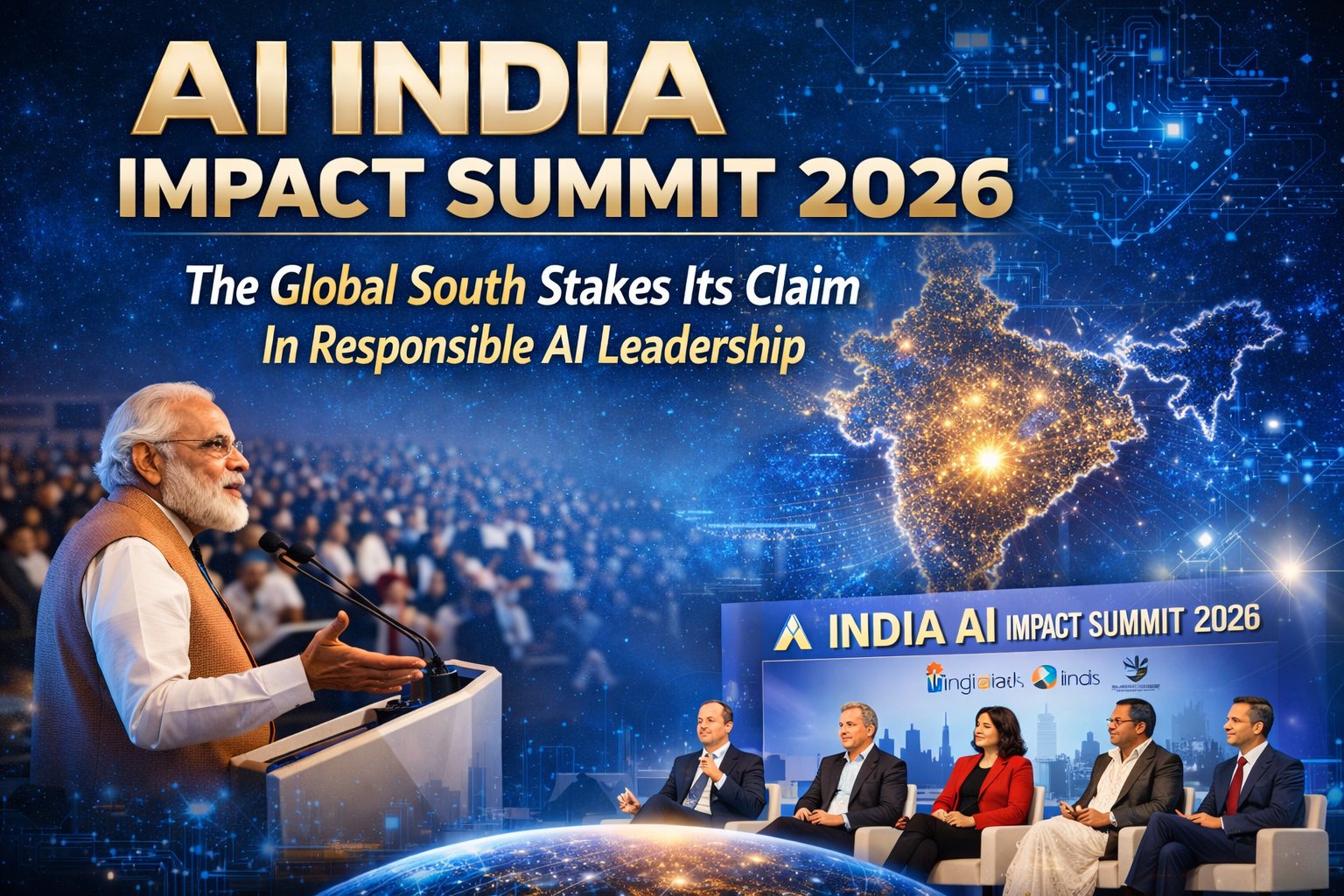
The AI India Impact Summit 2026, hosted at Bharat Mandapam in New Delhi, marked a decisive chapter in that transition. Far from being a regional gathering, the summit positioned India and the broader Global South as active architects of responsible AI adoption rather than passive recipients of imported frameworks.
For American technology leaders, policymakers and enterprise strategists, the summit offered more than optics. It provided a preview of how AI governance, workforce design and cross sector partnerships may unfold across high growth markets over the next decade.
Opening Plenary And Global Leadership Address
Prime Minister Narendra Modi
“AI can be a force for welfare for all and happiness for all.”
He framed India’s AI direction around People, Planet and Progress, positioning AI as a tool for inclusive growth rather than narrow technological advancement.
Rishi Sunak
“Across the world, we are seeing very different attitudes towards AI. In countries like India, there is enormous optimism and trust. In Western countries, anxiety still dominates. Closing that confidence gap is as much a policy task as it is a technical one.”
He emphasised that trust building, governance clarity and responsible deployment must evolve alongside innovation.
Dick Schoof
“AI is booming here in India. Middle powers can lead in responsible and collaborative AI development.”
He highlighted India’s growing global influence in shaping practical and responsible AI frameworks.
Technology Leadership And Industry Transformation Sessions
Sundar Pichai
“India is poised for an extraordinary AI trajectory.”
He pointed to India’s scale, digital public infrastructure and developer ecosystem as foundational strengths for rapid AI acceleration.
Alexandr Wang
“Personal agents are AI’s next massive leap and opportunity. These agents will help carry out personal and professional tasks efficiently.”
He outlined a shift from generic tools to deeply personalised AI systems integrated into daily workflows.
Tech Leaders Workforce Panel
“AI is happening. It is relentless. Set a personal target of learning how to use three AI platforms within the next three months. The more you do that, the more your job is safe.”
The panel reinforced that adaptation, upskilling and proactive experimentation are now baseline expectations.
Vinod Khosla
“By 2030, there will be no IT services industry and no BPO industry left. This shift will be very, very disruptive.”
His perspective challenged India’s traditional outsourcing model, urging a pivot towards product innovation and AI native enterprises.
Government And Policy Dialogue
Ashwini Vaishnaw
“India is focused on AI for real world problems like healthcare, agriculture, climate change and enterprise productivity. This summit brings that opportunity.”
He positioned AI as a national development lever rather than a purely commercial technology wave.
Global Governance And Strategic Alignment Session
George Osborne
“Countries that do not embrace AI could be left behind.”
He underlined AI adoption as a geopolitical and economic imperative, not merely a technological choice.
From Policy Rhetoric To Implementation Architecture
One of the defining characteristics of the summit was its refusal to linger in abstract principle. Sessions repeatedly pivoted from ethical declarations to operational frameworks. How should healthcare datasets be governed across federal and state jurisdictions? What does secure data exchange look like in emerging markets? How can AI systems be audited at scale without paralysing innovation?
Panels on trusted data ecosystems and interoperable infrastructure underscored that AI performance depends as much on governance architecture as on model sophistication. Speakers argued that data collaboratives must balance accessibility with accountability, enabling secure exchange across ministries, hospitals, financial institutions and research networks.
For an American audience accustomed to debates centred on large model capability and private sector competition, the emphasis on public infrastructure design was striking. The summit highlighted that the future of AI may hinge less on incremental algorithmic improvements and more on cross institutional trust.
Responsible AI As An Economic Strategy
A recurring theme was that responsible AI is not a compliance burden but a competitiveness lever. Governments across Asia and Africa are increasingly framing ethical AI adoption as an economic growth strategy. By embedding transparency, bias mitigation and explainability into procurement standards, they aim to create stable innovation environments that attract long term investment.
This approach challenges a common misconception that emerging markets prioritise speed over safeguards. Instead, summit contributors emphasised that trust accelerates adoption. In sectors such as healthcare diagnostics or public benefits distribution, citizens are more likely to embrace AI enabled systems when governance mechanisms are visible and enforceable.
For US firms expanding into India and neighbouring regions, this presents both opportunity and obligation. Competitive advantage may depend on demonstrating alignment with local governance expectations rather than exporting standardised global templates.
Healthcare As The Proving Ground
Healthcare dominated much of the agenda, reflecting India’s scale and its ambition to deploy AI across diagnostics, supply chains and population health analytics.
Speakers examined how AI models trained on diverse demographic data can reduce diagnostic bias. Others discussed predictive systems supporting rural telemedicine networks. The conversation was pragmatic rather than promotional. Implementation challenges were openly acknowledged, including data fragmentation, cybersecurity vulnerabilities and skills shortages.
The takeaway for American medtech and healthtech enterprises is clear. High population density markets offer unmatched scale for real world validation of AI systems. Yet deployment success will require deep collaboration with public agencies and academic institutions rather than standalone product launches.
Workforce Transformation At Scale
Another defining strand of the summit addressed workforce evolution. As AI automates routine processes, new skill architectures must emerge. Panels explored how universities, enterprises and civic organisations are co designing curricula that integrate data literacy with domain expertise.
Several speakers highlighted programmes aimed at training hundreds of thousands of professionals in responsible AI principles. The emphasis was not simply on coding skills but on interdisciplinary fluency. Clinicians, public administrators and financial regulators must understand algorithmic systems well enough to question, interpret and govern them.
For American corporations facing similar transitions, the message resonates. Sustainable AI adoption demands internal capacity building that extends beyond technical teams into compliance, legal and operations functions.
Supply Chain Resilience And Digital Traceability
Beyond policy and workforce themes, operational resilience surfaced as a priority. The summit examined how AI driven analytics can enhance supply chain transparency across pharmaceuticals, medical devices and critical materials.
Regionalisation strategies were discussed as a hedge against geopolitical volatility. AI tools that provide real time traceability, predictive inventory management and automated compliance documentation were positioned as enablers of stability.
For US enterprises managing global operations, these insights carry strategic weight. Markets in the Global South are not merely consumer endpoints but integral nodes in diversified supply architectures.
Multi Stakeholder Collaboration As The Core Model
Perhaps the most consequential message of the summit was structural. Responsible AI cannot be delivered by government mandate alone or by corporate initiative in isolation. It requires multi stakeholder alignment.
Sessions brought together policymakers, researchers, development finance institutions and industry leaders to explore public private partnership models. Capacity building initiatives were highlighted as vehicles for equitable access, ensuring that AI benefits are distributed rather than concentrated.
This collaborative framing contrasts with more adversarial narratives often present in Western regulatory debates. While tensions around data sovereignty and market competition were not ignored, the summit prioritised constructive architecture over polarised positioning.
Implications For American Technology Strategy
For an American readership, three implications stand out.
First, global AI governance will be multipolar. Standards shaped in India and across the Global South will increasingly influence procurement frameworks and interoperability norms.
Second, scale experimentation in populous democracies may accelerate model validation in areas such as public health analytics and financial inclusion.
Third, competitive differentiation may rest on ethical integration as much as on computational power.
The AI India Impact Summit 2026 demonstrated that emerging markets are not simply adopting AI. They are designing frameworks that reflect demographic diversity, public accountability and inclusive growth objectives.
Beyond Symbolism: A Strategic Inflection Point
It would be easy to interpret the summit as another conference in a crowded calendar. That would be a mistake. The scale of ambition, the clarity of policy direction and the operational detail shared across sessions suggest something more durable.
India’s positioning is deliberate. By hosting global stakeholders and foregrounding responsible AI adoption, the country is signalling readiness to influence the next phase of digital governance.
For American AI leaders, engagement with these ecosystems should not be viewed as peripheral diplomacy. It is strategic foresight.
The AI era is no longer defined solely by who builds the largest models. It will be shaped by who builds the most trusted systems. The AI India Impact Summit 2026 made clear that trust, at scale, is the new frontier.
The inaugural morning of 19 February at Bharat Mandapam was conducted under strict access protocol, underscoring the stature of the gathering. The opening ceremony and select high level sessions were invite only. Entry required physical passes issued in advance. Standard delegate QR credentials were not valid for these proceedings. Guests were required to be seated by 7.30 am, reflecting both security discipline and the significance of the occasion.
The exclusivity of the inaugural session mirrored the calibre of those in attendance. The summit convened senior government officials, global technology executives, multilateral leaders and venture investors who collectively shape the trajectory of AI governance and deployment worldwide.
Among the prominent attendees were:
-
Brad Smith, President and Vice Chair, Microsoft
-
Børge Brende, President and CEO, World Economic Forum
-
Cristiano Amon, President and Chief Executive Officer, Qualcomm Incorporated
-
Arthur Mensch, Co Founder and CEO, Mistral AI
-
Alexandr Wang, Chief AI Officer, Meta
-
Ana Paula Assis, Senior Vice President and Chair Asia Pacific and EMEA, IBM Corporation
-
Anne Neuberger, Strategic Advisor, Andreessen Horowitz
-
Aparna Bawa, Chief Operating Officer, Zoom
-
Amit Zavery, President and Chief Product Officer, ServiceNow
-
Arundhati Bhattacharya, Chairperson and CEO, Salesforce India
-
Borje Ekholm, President and CEO, Ericsson Group
-
C Vijayakumar, Chief Executive Officer and Managing Director, HCLTech
-
Dame Melanie Dawes, Chief Executive, Ofcom
-
Carme Artigas Brugal, Senior Fellow, Harvard Belfer Center and ADIALab
-
Bipul Sinha, CEO, Chairman and Co Founder, Rubrik
-
BVR Mohan Reddy, Founder and Chairman, Cyient Ltd
-
Aarthi Subramanian, Chief Operating Officer and Executive Director, Tata Consultancy Services
-
Ajay Vij, Senior Country Managing Director, Accenture India
-
Akhilesh Tuteja, Head of Clients and Industries, KPMG India
The diversity of representation was notable. Global hyperscalers stood alongside European regulators. Venture capital voices shared space with multilateral institutions. Indian technology leaders engaged directly with policymakers and research scholars. The presence of both public and private sector heavyweights reinforced the summit’s positioning as a serious policy and implementation forum rather than a purely commercial showcase.
The summit was powered by the IndiaAI Mission under the Ministry of Electronics and Information Technology, signalling clear state level commitment to positioning India as a steward of responsible and scalable AI systems.
For observers from the United States, the attendee composition offered a revealing signal. This was not a domestically focused technology event. It was a strategically curated convergence of decision makers capable of shaping global standards, influencing procurement frameworks and accelerating cross border AI collaboration.
The controlled access of the inaugural proceedings, combined with the presence of global industry and governance leaders, reinforced one central message: the AI India Impact Summit 2026 is not merely a conference. It is a platform where geopolitical, economic and technological agendas intersect in real time.
While the inaugural proceedings on 19 February were conducted under strict invite only protocol at Bharat Mandapam, the broader summit architecture was intentionally designed for global reach.
All key sessions, thematic tracks and expert panels from the AI India Impact Summit 2026 are available for virtual exploration through the official summit platform. International audiences, including policymakers, researchers, enterprise leaders and AI strategists across North America, Europe and Asia Pacific, can review session details, speakers and thematic focus areas online.
The digital interface enables participants to:
-
Browse plenary and breakout sessions across governance, healthcare, workforce, infrastructure and AI for social impact
-
Explore speaker profiles spanning global technology firms, regulatory bodies, academic institutions and venture ecosystems
-
Track specialised tracks such as AI for health, AI for agriculture, AI in education and AI for gender empowerment
-
Follow working group discussions and research symposium outcomes
This hybrid design signals strategic intent. The summit is not positioned as a closed door diplomatic forum but as a globally accessible knowledge exchange. By enabling virtual participation, organisers ensure that conversations shaping responsible AI adoption in the Global South are visible to global stakeholders, including American enterprises evaluating partnership or market expansion strategies.
The approach also reflects a broader governance philosophy championed by the IndiaAI Mission. Transparency, interoperability and shared learning are treated as foundational to responsible AI ecosystems. Virtual access extends the policy dialogue beyond the physical venue, reinforcing India’s aspiration to contribute meaningfully to global AI standards.
For readers of AI Reporter America, the availability of online session archives offers a direct window into how one of the world’s most populous democracies is structuring its AI governance, public sector integration strategy and international collaboration model. The conversations are not peripheral to global AI evolution. They are increasingly central to it.
Watch Now
https://impact.indiaai.gov.in/sessions