Thursday, 19 November 2026

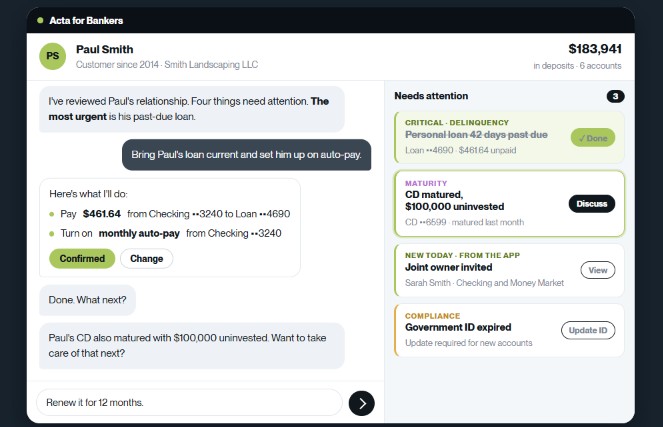
Image source: Public Domain
Savana, the digital delivery platform for financial institutions, announced Savana Acta, operational AI that completes complex banking tasks in conversation within the policies, permissions, and approvals established by each financial institution.
While conversational AI has made it easier for customers and employees to interact with financial institutions, completing a banking task often still requires work across multiple systems, processes, and approval steps. Acta bridges that gap, carrying requests through to completion across the systems that power banking operations. At launch, Acta supports 139 banking actions across servicing, money movement, cards, account opening, and more.
“The first wave of AI in banking was about knowing more. The next is about doing more,” said Mike Wolfel, CEO of Savana. “Banks and credit unions don’t need another tool that tells them what to do next. They need AI that can carry out the work across their operations.”
Customers don’t think in banking workflows. They’re buying a home, having a child, or getting married. Acta turns those life events into a series of actions, going beyond guidance or pointing customers somewhere else, so they can get things done with the bank’s controls in place.
Acta brings operational AI to both bank employees and customers
Acta for Bankers lets staff handle requests end-to-end without leaving the conversation. For example, a banker can ask Acta to review a personal loan that’s past due. Acta confirms the funds are available in checking, makes the payment with the banker’s approval, and enrolls the loan in auto-pay. The banker can complete the entire process within the same conversation, rather than navigating multiple systems and manually coordinating each step. Nothing is left pending.
Acta for Customers brings that capability to self-service, within limits the institution sets, so customers can complete tasks rather than simply receive instructions. For example, a customer can say, “I just got married. Can you add my wife, Sarah, to my accounts?” Acta understands what that means and offers to update the customer’s marital status and name Sarah as the IRA beneficiary. Once the customer confirms, Acta completes all three tasks in the same conversation. If a customer would like to speak to a person, a banker picks up the same conversation with full context.
In both experiences, nothing happens until a person approves it, and Acta can only do what the institution’s policies and that person’s permissions already allow. Every action is recorded on a tamper-evident audit trail, providing financial institutions with a record of the steps taken, the approvals involved, and the outcomes of each interaction. This gives institutions visibility into how AI-driven work is carried out while maintaining the controls and accountability required in banking. Acta is also model-agnostic, so institutions choose the AI models that fit their technology, risk, and governance strategies.
Built for the complexity of banking operations
Financial institutions operate across increasingly complex technology environments, often relying on multiple core systems, acquired platforms, and disconnected applications. Employees frequently have to bridge these systems manually to complete even routine banking activities.
Banking AI is only as useful as its ability to interact with the systems where banking work actually happens. Rather than introducing another standalone AI tool, Acta’s approach is designed to work across the systems and workflows that already power a financial institution.
Savana’s core-agnostic platform connects core banking systems, CRM, digital channels, and third-party applications. It supports traditional, modern, and multi-core environments, enabling financial institutions to modernize operations without a core conversion or a wholesale replacement of their existing technology.
This connected foundation enables Acta to coordinate work across systems that may not otherwise communicate effectively, helping financial institutions move beyond isolated AI interactions to completed banking processes.
“The hard question in banking AI isn’t whether it can answer. It’s whether you can prove what it did and why,” said David Williams, CTO of Savana. “We built Acta so that answer is never a reconstruction. Every action runs through the bank’s own controls, is approved by a person, and lands in a tamper-evident record. That’s what moves AI from pilot to production.”