Wednesday, 04 November 2026

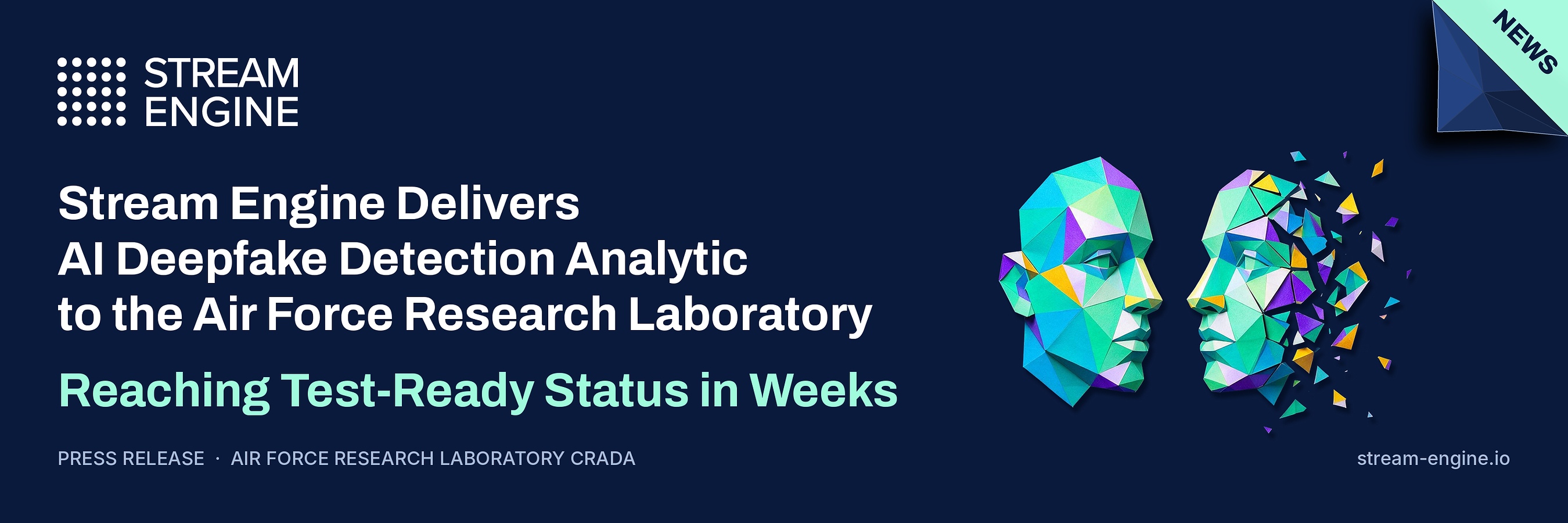
Image source: Public Domain
Stream Engine, a provider of decision intelligence for national security, announced that it has developed and delivered a containerized, semantic-based deepfake detection analytic to the Air Force Research Laboratory (AFRL) Information Directorate under a Cooperative Research and Development Agreement (CRADA). According to AFRL's CRADA annual report (Case No. AFRL-2026-4061), the analytic has been integrated into AFRL's new Test and Evaluation (T&E) testbed, the testbed is fully operational, and the system was ready for formal T&E as of June 2026. AFRL recommended that the CRADA effort continue.
The CRADA was executed on June 6, 2025, for a 12-month term, with a primary technical objective of integrating and evaluating semantic-based deepfake detection technologies. At the project kickoff, the Joint Work Plan was restructured to maximize value for both parties: Stream Engine would build a semantic-based deepfake detection analytic from the ground up, while AFRL used the integration to stress-test and mature its newly established T&E testbed.
From language models to likelihood scores
Stream Engine applied its large language model (LLM) expertise in text analysis to build a two-stage detection pipeline. First, a semantic feature extraction model analyzes text along two dimensions: grammatical and syntactic anomalies, and semantic inconsistencies across the text. A neural network classifier then combines these features into likelihood scores designed to separate machine-generated text from human writing that is simply poorly written. Surface-level fluency cues alone cannot reliably draw that line.
Stream Engine packaged the analytic as a container built on an AFRL-engineered Docker template, which allowed secure deployment into the T&E testbed. AFRL supplied synthetic and manipulated datasets for training, along with a custom software environment for integration and testing. AFRL's report cites "improved technology or software" as a technology transfer benefit to the Air Force.
Test-ready despite headwinds
The team reached test-ready status while working through a facility power outage, a six-week federal government shutdown, and the approvals required to access the testbed. AFRL reported that the T&E environment was successfully configured in June 2026 and that the testbed is ready for use in this and future programs.
No federal funds were exchanged under the agreement. The parties estimated Stream Engine's contributions over the 12-month period at more than $1 million, including personnel, intellectual property, supplies and equipment.
"We were asked to take our language intelligence and point it at one of the hardest problems in national security: telling whether content was written by a person or manufactured by a machine," said Brian Kim, co-founder and CEO of Stream Engine. "Our team built that analytic from the ground up, delivered it in a deployable container, and now it sits in AFRL's testbed ready for formal evaluation. That is the pace this mission demands, and it reflects what Stream Engine is built to do: turn signals into decision intelligence for the people protecting the country."