Monday, 23 November 2026

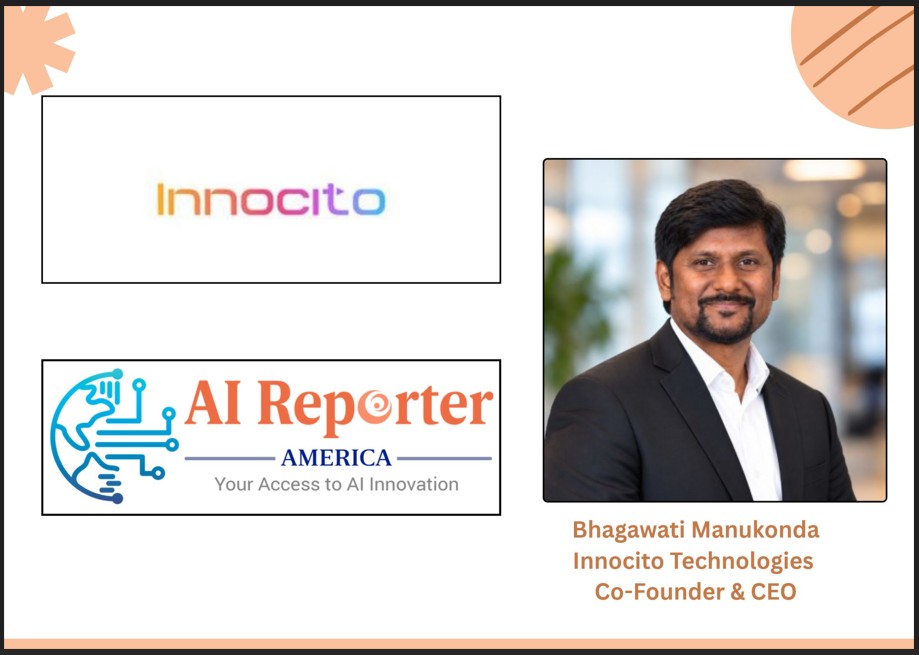
As enterprises accelerate AI adoption in software development, faster code generation is exposing new bottlenecks across testing, security reviews, release approvals, and regulatory compliance. Addressing this gap, Innocito has introduced Innoverse, an agentic software factory designed to connect the entire software development lifecycle through specialized AI tools for planning, coding, testing, security, operations, and governance. The platform combines shared agent context, structured engineering workflows, and mandatory human approval gates to help organizations accelerate software delivery while maintaining transparency, accountability, and audit readiness. In an exclusive conversation with AI Reporter America, Bhagawati Manukonda, Co-Founder and CEO of Innocito Technologies, discussed how Innoverse is moving enterprise software engineering beyond AI-assisted coding toward end-to-end, governed, and outcome-driven delivery.
1 What drove Innocito to introduce Innoverse as an agentic software factory?
We built Innoverse because AI was making one part of software delivery fast and leaving the rest where it was.
Over the last two years, coding assistants changed how quickly code gets written. Writing code was never the whole job, though. A change still has to be planned, reviewed, tested, secured, released and monitored, and in regulated industries someone has to defend it in an audit. In most enterprises those steps are still manual and spread across separate teams and tools. The bottleneck didn’t go away. It moved downstream into QA queues, security reviews and release approvals.
Quality engineering is where Innocito comes from, so we saw this up close. Clients were producing more code than ever and felt less sure about what they were shipping. Their boards kept asking what the AI budget had actually delivered, and faster code on its own wasn’t an answer.
We started building agents for our own delivery work to close that gap, and about a year ago we began running our own client projects through them. That year taught us a lot: where agents really save time, where they need an engineer next to them, and what evidence auditors and CIOs ask for when they review a release. Innoverse came out of that work.
The word “factory” is deliberate. A good factory has stations, quality checks between them and a record of what happened at each one. Innoverse works the same way. A release moves through six stages, an engineer approves each handoff and every action is logged.
The early results gave us the confidence to take it to more clients. At a healthtech client, teams shipped 50 percent more work per sprint. For a transportation client, we built a new platform three times faster than planned.
There’s a business reason as well. We’re moving Innocito to a Forward Deployed Engineering model, where our engineers work inside client teams and are measured on outcomes instead of hours billed. You can only promise outcomes when delivery is predictable and you can prove what happened. Innoverse gives us both.
2 How does Innoverse automate the end-to-end software development lifecycle?
Innoverse runs a release as one connected flow through six stages, and each stage has its own tool.
Two more tools sit underneath all six stages. InnoGateway routes and meters every model call, so AI usage and cost are visible. InnoFabric gives the agents shared context, connectors and guardrails. The testing agent knows what the planning agent decided, and the security agent knows exactly what changed.
That shared context is what makes it end to end. Without it you’d have six separate automations and people copying information between them. With it, the requirement written in Atlas becomes the basis for the tests InnoTest writes, and a finding from InnoHawk points to the exact change Regent produced. When InnoNexus spots an incident in production, it goes back to Build as a fix.
Take a simple change, like adding a field to a customer onboarding form. Atlas turns the request into work items and acceptance criteria. Regent writes the change. InnoTest builds tests from those same criteria, so it’s checking what was asked for and not only what was built. InnoHawk checks the pull request for anything risky, such as how the new data is stored. InnoNexus watches the release once it’s live, and InnoInsights records which controls the change touched. An engineer signs off at each step, and the whole history sits in one place.
At every handoff there’s a gate where an engineer approves the work before it moves on. Those gates matter more than any single agent, and the oversight answer below explains how they work.
Innoverse also runs inside the client’s own environment, in their cloud, on their keys and with the models they’ve approved. Nobody has to move code or data somewhere new to use it.
3 What sets Innoverse apart from traditional AI coding assistants?
A coding assistant helps one developer write code faster. Innoverse is meant to get a whole release into production safely, with proof of how it got there. The two problems are related, but they aren’t the same.
Our engineers use coding assistants every day, and they’re good at what they do. They work at the level of a file or a function inside one person’s editor, though. They can’t tell you whether the change was tested against the requirement, whether it opened a security hole, or whether the release will stand up to an audit. That part is still left to people and a patchwork of tools.
The first difference is scope. Planning, building, testing, security, operations and governance run as one flow in Innoverse. If you speed up coding and leave everything after it manual, the queue just moves. We wanted to get rid of it.
The second is how decisions get made. An assistant suggests something and a developer takes it or leaves it. Innoverse has formal approval points where an accountable engineer signs off before anything moves forward, so there’s always an answer to who approved what.
Third, it leaves a record. Every agent action, model call, test result, security finding and approval is captured, so each release comes with its own audit trail.
Fourth, it runs on the client’s terms: their cloud, their keys, their approved models. Every model call goes through InnoGateway, which meters it and scores it for quality and safety. A lot of enterprises hold back on AI because they can’t see what it’s doing. We designed for that worry from day one.
How it reaches clients is different too. Innoverse is Innocito’s own intellectual property, and our engineers bring it into client teams, so clients don’t have to buy a tool and work out adoption alone. When an engagement ends, they keep the code, the evaluations and the runbooks.
4 How do its specialized AI agents streamline coding, testing, and security?
First, a word on what the agents are. Innoverse is made up of eight tools, and each one is built from its own agents, integrations and skills for a specific job. A tool that only tests, or only looks for security risk, can be held to a far higher bar than a general agent asked to do everything.
Coding. Regent writes code meant to be merged. It works from the plan Atlas produced, so it builds against an agreed requirement instead of a loose prompt. Its output comes through as a reviewable change, and an engineer reviews it before it goes any further. A lot of rework disappears at that point, because problems get caught at the handoff and not three stages later.
Testing. This is where AI-accelerated teams usually feel the most pressure, because code shows up faster than anyone can write tests for it. InnoTest works from what teams already have. It can take a Jira or Azure DevOps ticket, a plain-English description, a screen recording of someone using the application, or access to the repository, and turn it into working Playwright or Selenium scripts plus reports a QA lead can review. Testers who used to spend days scripting a regression suite can put that time into coverage and edge cases.
Here’s a typical case. A team logs a bug in Jira. InnoTest reads the ticket, writes a Playwright test that reproduces the problem, runs it against the fix and attaches the result to the change, so the reviewer can see the bug is gone before approving it. That same test then joins the regression suite, so the bug can’t quietly come back.
Security. InnoHawk checks every pull request and automates penetration testing, so security happens as the code changes and not in one review at the end. Each finding is tied to the change that caused it, which makes it quicker to fix and easier to show it was fixed.
The bigger gain comes from the tools sharing context through InnoFabric. The tests know what the code was meant to do, and the security findings know which test run they belong to. People stop copying details from one tool into another, and fewer things get lost at the handoffs.
5 How does the platform maintain human oversight across engineering workflows?
Oversight is built into how work moves through Innoverse, so nobody can switch it off to go faster. Agents do the work between stages, and people make the call at each one.
Every release passes five gates:
Work doesn’t move until the gate is passed. That gives clients a straight answer to the question every CIO is now asking about AI: who approved this?
We thought hard about where to put people. If you ask someone to approve every small agent action, they start clicking yes without reading, and the oversight is only for show. So the gates sit where judgment counts: is the plan right, is the code sound, is the testing enough, is the risk acceptable, should we ship. Between those points the agents run at full speed.
The gates also come with context. An engineer reviewing a change sees the requirement it came from, the tests written for it and any security findings in one place. Nobody can make a good call with half the picture.
Every approval is recorded along with the evidence the approver saw. If a decision gets questioned six months later, the record shows who made it, when, and what they were looking at.
This also shapes how we work with clients. Our forward-deployed engineers sit inside client teams, and the client’s own engineers hold the gates on their releases. Agents take on the routine work so teams can save their judgment for the decisions that need it.
6 How does Innoverse ensure compliance, governance, and accountability?
Our starting point is simple. If you can’t show what happened, you can’t prove it was done properly. So Innoverse records the work as it happens.
Each release has an evidence log. Every agent action, model call, test result, security finding and human approval is captured. When an auditor asks how a change was tested, who reviewed it or whether a known vulnerability was dealt with, the answer is already there. Nobody has to piece it together from emails and tickets weeks later.
Think about a common audit request: show me how this change to the payments flow was tested and who approved it. In most companies that means days of searching through tickets and chat threads. With Innoverse, it means opening the release record.
InnoInsights maps each release to the frameworks the client is audited against, including the EU AI Act, GDPR and SOC. Compliance stops being a separate exercise at the end of the quarter, because each release carries its own mapping. For clients in healthcare, financial services and other regulated sectors, an audit becomes a review of records that already exist.
The AI itself also needs governing. Enterprises are right to ask how they control AI that writes and changes their software. Every model call goes through InnoGateway, which meters it and scores it for quality and safety, so clients can see which models are used, for what and at what cost. Innoverse runs in the client’s cloud, on their keys and with models they approve, so sensitive code and data stay under their control.
Accountability comes from the five gates. Every stage of every release has a named approver, and “the AI did it” is never the answer to who signed off.
Ownership matters too. When an engagement ends, clients keep the code, the evaluations and the runbooks. Good governance includes not being locked into a vendor you can’t inspect.
We apply the same standard to ourselves. Innocito is ISO 27001 and ISO 9001 certified, and we ran Innoverse on our own projects for a year before offering it to clients.
7 How could agentic AI reshape the future of enterprise software engineering?
The biggest change probably won’t be how fast code gets written. It will be what engineers spend their time on, and how companies prove that what they ship is safe.
Engineering work will shift toward judgment. A large share of today’s effort goes into things agents handle well: boilerplate, regression scripts, routine security findings, release paperwork. As agents take that on, the scarce skills become deciding what to build, judging whether it was built right and owning the risk of releasing it. Our gates are an early version of that. Engineers spend more of their day approving, challenging and directing, and less of it typing.
This isn’t a story about fewer engineers. Demand for s*ftware keeps growing faster than the number of people who can build it. Agents let the same team take on more work, and do it with a better record of how it was done.
Delivery will increasingly be paid for by results. When agents do much of the work, billing by the hour makes less sense. Clients will want to pay for releases shipped, defects that never reach production and audits passed. That’s why we’re moving Innocito to a Forward Deployed Engineering model, and we expect a good part of the services industry to follow.
Governance will move into the pipeline. The EU AI Act is only the beginning. Boards and regulators will want to know how AI-built software was tested, reviewed and approved. Companies that capture that evidence as they work will move faster than those trying to reconstruct it afterward, and compliance will stop being a separate function bolted onto engineering.
And trust, more than capability, is now the limit. The agents are already capable. What holds most enterprises back is confidence that AI won’t bring in risks they can’t see, and that someone stays accountable. The platforms that earn a place will be the ones that make AI’s work visible and keep people in charge of the decisions that matter.
Nobody has every answer on how this plays out, which is why we’re inviting enterprise technology leaders to join the Innoverse advisory board and help decide where the platform goes next. If you’re working through these questions in your own organization, we’d like to hear from you.