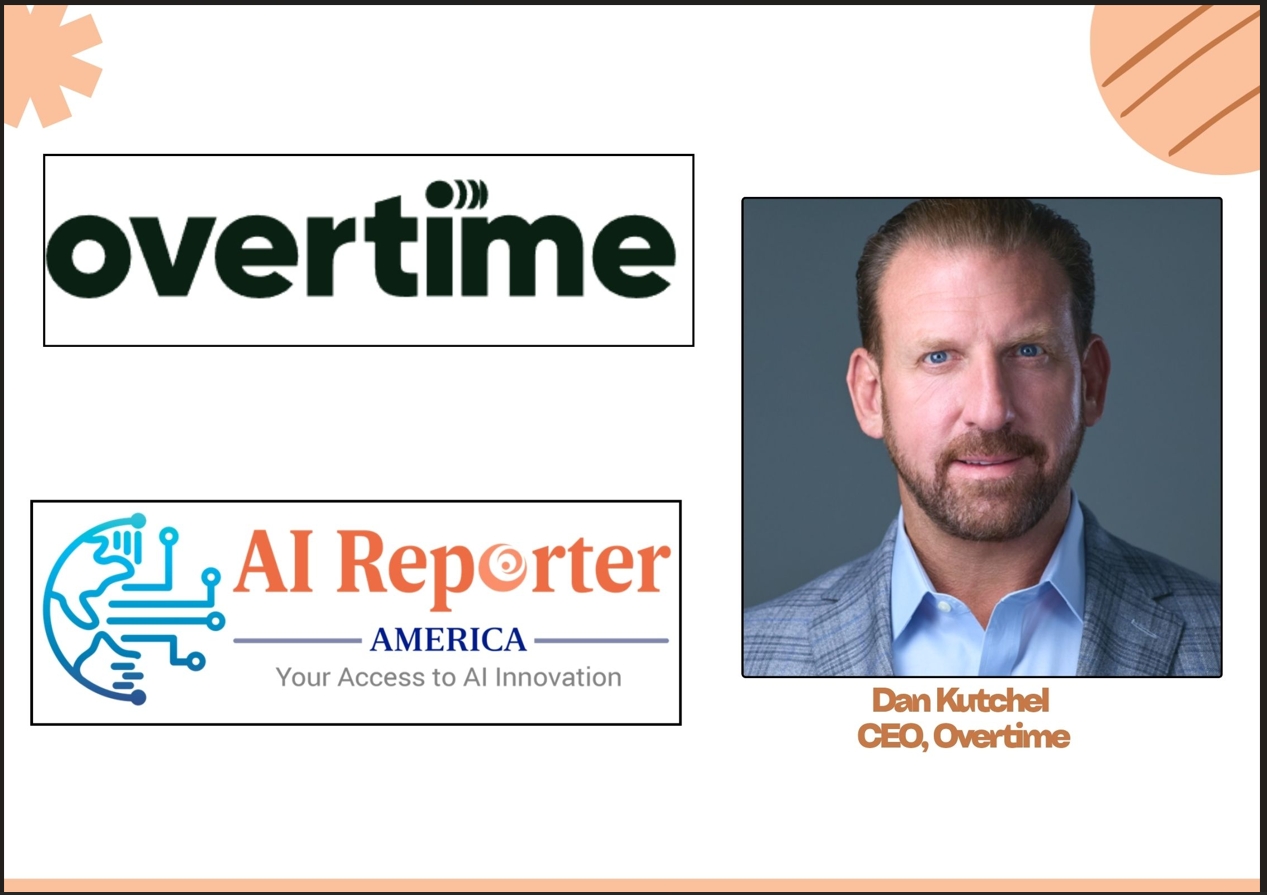
Collections automation has long focused on making more calls, sending reminders and triggering workflows—but what happens when AI can actually manage the conversation? In a conversation with AI Reporter America, Dan Kutchel CEO of Overtime explained how its voice-first AI agents are designed to engage consumers, address questions and objections, and guide interactions toward payments or promises-to-pay, while operating within defined business rules and regulatory guardrails.
1. What inspired Overtime’s voice-first AI approach to billing and collections?
The idea came from a very practical problem: there are simply more accounts that need a meaningful conversation than most organizations have trained people available to handle.
In collections and first-party receivables, a large portion of conversations with consumers can go untouched because organizations have to prioritize where the limited capacity of their team goes. This is not the type of work where you can sacrifice quality or compliance just to increase activity. More conversations does not equal better business outcomes. Every conversation with a consumer must be respectful and in line with the organization’s client, regulatory, and brand requirements.
This makes voice-first AI a natural place to focus. We empower organizations with AI agents to improve recovery performance, cost to collect and consumer experiences, as well as ensure compliance is built in at every step. Consumers can have a conversation with an AI agent to clarify a balance, answer their questions, address any potential objections, and be moved toward payment, promise-to-pay or the appropriate next step. Overtime’s AI adds invaluable scale for the organization in connecting with more consumers, while enabling human agents to be tapped in at appropriate moments when human empathy, creativity or advanced problem solving is needed. For example, judgment matters most in complex disputes, hardship and exceptions situations, and these conversations might be best managed by trained employees.
2. How does Overtime help teams improve recovery while lowering collection costs?
Traditional collections teams have finite capacity. As account volume rises, organizations generally have to increase staff, prioritize a smaller portion of conversations, and accept that some accounts will receive little meaningful attention. Overtime helps teams connect with more consumers through AI-driven voice conversations and follow-up at all hours of the day, while reserving their human expertise for the cases where it adds the most value. With more accounts worked, more consistent follow-up, and greater capacity without having to build an equally large staffing infrastructure around it, Overtime improves recovery while lowering cost-to-collect.
The platform is more powerful than simply increasing call volume. It uses account information and operating rules to help determine factors such as contact strategy, timing, cadence and next-best action, then measures outcomes including promises-to-pay and recovery performance. Every interaction can be documented and evaluated, giving organizations visibility into what is actually producing results.
3. What differentiates Overtime from traditional collections automation?
Traditional automation is typically good at generating activity. It can dial a number, send a reminder, trigger a workflow, or route someone through a scripted interactive voice response (IVR). Those can be useful capabilities, but activity is not the same thing as delivering resolutions and other business outcomes.
Overtime is designed to conduct and manage the actual collections conversation. Our AI agents work toward defined outcomes such as a payment, a promise-to-pay, a follow-up or an escalation to a human agent. The conversation operates within configured goals, business rules and compliance guardrails rather than functioning as an unrestricted chatbot.
Another important distinction is that the platform was purpose-built around collections and receivables operations. That matters because the hard part is rarely producing a convincing AI demonstration. It’s putting technology into a live environment where contact policies, disclosures, consent, disputes, client requirements, auditability, and performance all coexist. Overtime was built by leaders with decades of experience across collections, healthcare revenue cycle, debt buying, and first party servicing, who understand that success can’t simply be measured by volume of conversations. It needs to be measured by meaningful business outcomes: recovery performance, cost to collect, compliance, and consumer experience.
4. How does the platform balance AI-driven conversations with regulatory compliance?
The collections industry is regulated, and compliance cannot be a layer added after the AI has been built. It has to govern how the system operates from the beginning.
Overtime allows organizations to define the policies and guardrails within which the AI can conduct a conversation. The platform supports controls around approved and prohibited language, call timing and frequency, consent and opt-out requirements, client-specific policies, disputes, cease-and-desist situations and escalation paths. Interactions are also recorded, transcribed, and documented to support monitoring and auditability.
That is an important distinction from giving a general-purpose AI model an instruction and hoping it consistently behaves the right way. In collections, one poorly handled interaction can have a very different consequence than a poor interaction in a typical customer-service setting.
AI can help organizations scale engagement, but scale only creates value if the organization remains in control. The objective is to give operators the efficiency of AI while maintaining clear policies, visibility, and human escalation where appropriate.
5. How does voice AI improve contact rates and promises-to-pay?
The first advantage is broader coverage across an organization’s portfolio. AI enables organizations to consistently engage accounts that human teams may not have had the capacity to reach, or where outreach may not previously have been cost-effective.
The second advantage is what happens once contact with a consumer occurs. A voice interaction can move beyond a notification and actually engage the consumer, verifying the appropriate party, responding to common questions or objections, discussing the account and guiding the conversation toward an agreed next step. Overtime can also use account context to inform timing, cadence, and engagement strategy rather than treating every consumer identically.
Organizations using Overtime’s voice AI typically see measurable improvement in their contact rates, more promises-to-pay and incremental payments from previously unworked inventory within the first 30 to 60 days.
6. What challenges arise when deploying AI across sensitive collections workflows?
A common misconception is assuming that because an AI can carry on a conversation, it’s ready to operate in collections. Those are two very different standards.
The challenge is making sure the AI can operate safely and effectively inside a highly regulated collections workflow, not simply carry on a good conversation.
That requires several things to work together. The AI needs reliable account data and clear rules around what it can say, what it can do, and when it needs to stop or escalate. Compliance teams need visibility into consent, disclosures, contact frequency, disputes, and other regulatory requirements. Operations teams need confidence that the AI knows when to continue a conversation and when a human should take over.
And management needs to be able to measure whether the system is actually improving recovery performance, not just generating more calls or conversations for the sake of increasing activity.
That’s where domain expertise becomes critical. The AI provider has to deeply understand the regulatory requirements, the realities of the collections operation, and how to design a positive consumer experience. The technology matters, but the harder part is making it work reliably in a real-world setting.
7. How will the OH.io partnership accelerate Overtime’s growth across receivables markets?
Our partnership with OH.io bolsters our go-to-market capacity while letting the Overtime team stay focused on building our technology and delivering outcomes for customers.
OH.io is providing Overtime with an embedded go-to-market team, including a dedicated inside-sales pod and account-based marketing program focused on generating qualified conversations with prospective customers.
The timing matters. The market is moving from curiosity about AI in the collections toward much more significant questions about AI performance, compliance, and implementation. The partnership gives us the opportunity to get in front of more organizations having those conversations and demonstrate what voice AI looks like when it is built around the operating realities of receivables.