Wednesday, 23 September 2026

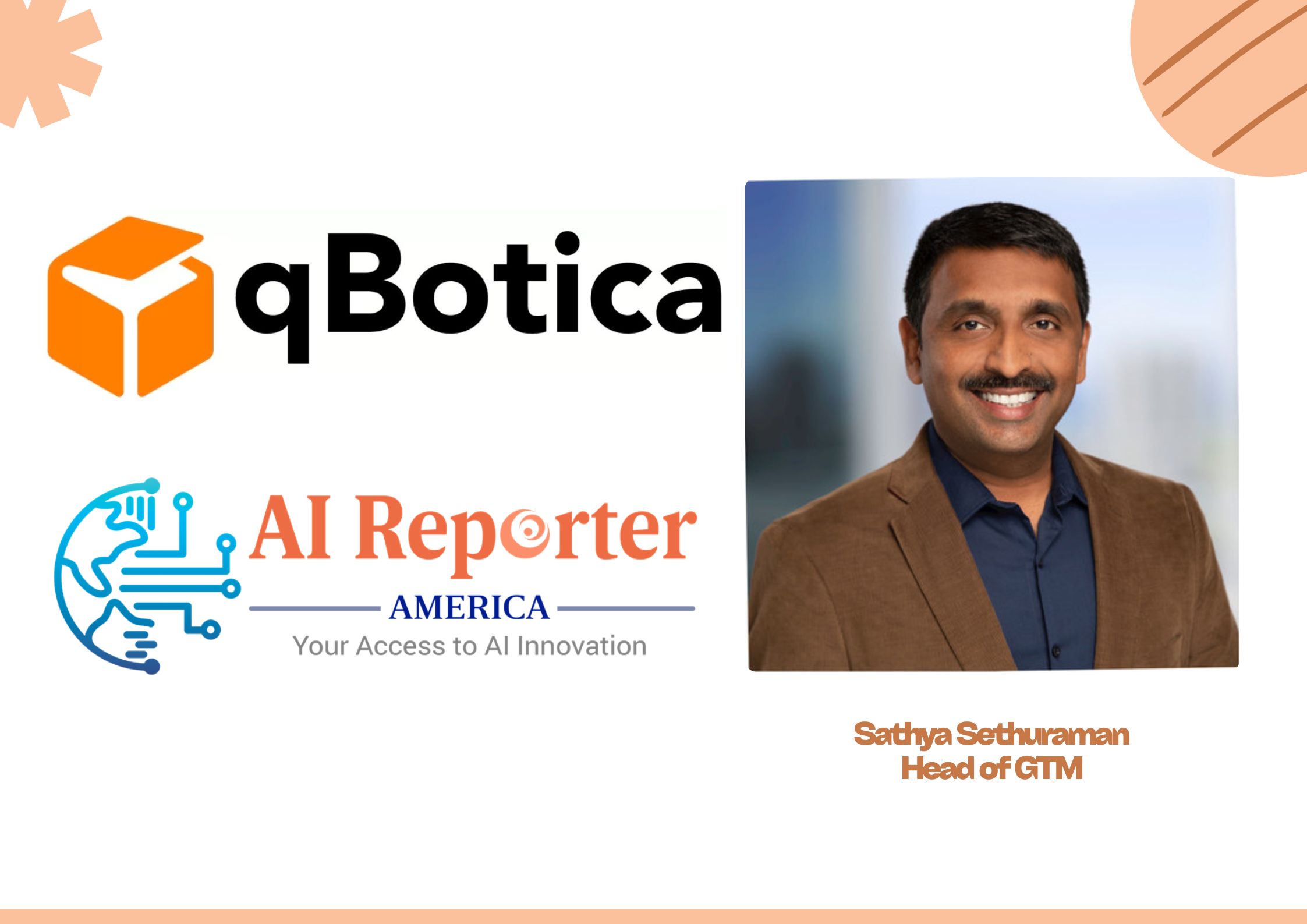
qBotica and Atolio have partnered to combine agentic AI with permission-aware, self-hosted enterprise search, enabling organizations—especially those in regulated industries—to deploy intelligent automation without compromising security, compliance, or control. In an exclusive conversation with AI Reporter America, Sathya Sethuraman, Head of GTM at qBotica, discussed how the partnership is helping enterprises unlock trusted, context-aware AI by securely connecting autonomous agents with governed enterprise data.
1. What enterprise knowledge challenges inspired this partnership?
Modern enterprises do not suffer from a lack of data; they suffer from data that sits behind walls of permissions, scattered across dozens of systems, and trapped in formats that automation cannot easily reach. A typical financial services firm runs critical workflows across Jira, Confluence, Slack, SharePoint, Google Drive, file servers, and a long tail of legacy applications. Each system has its own access model, its own taxonomy, and its own definition of “the source of truth.”
This fragmentation creates a paradox: organizations deploy AI agents to accelerate decisions, but those agents can only act on the slice of data they happen to be given. The result is automation that is fast but uninformed—handling claims without history, scoring loans without context, escalating tickets without policy awareness. The qBotica–Atolio partnership was born from a clear customer signal: regulated industries want agents that reason across the full enterprise knowledge base, not a sanitized subset of it.
2. How does permission-aware AI search improve the effectiveness of AI agents?
Permission-aware search is the difference between an agent that gives a confident wrong answer and one that gives a verifiable right one. Atolio mirrors document-level access controls in real time, so when a qubi agent retrieves information to support a decision—a policy lookup, a claims history, a vendor contract—it sees exactly what the requesting user is authorized to see, nothing more and nothing less.
For agents, this delivers three concrete gains. Accuracy improves because retrieval is grounded in current, authoritative content. Hallucination risk drops because answers can be traced back to real documents with cryptographic audit trails. And the agent itself becomes auditable: every action carries a complete decision lineage showing which documents were consulted and which permissions applied. In regulated industries, that audit trail is not a feature—it is the price of entry.
3. What differentiates this approach from traditional enterprise search solutions?
Traditional enterprise search was built for humans typing queries and scanning results. It assumed a person would catch a stale link, ignore an irrelevant hit, or notice a permissions error. Agentic AI breaks all of those assumptions. Agents query at machine speed, act on the first plausible answer, and do not pause to second-guess what they retrieve.
The qBotica + Atolio stack is engineered for that new reality. It is agent-native rather than human-first: sub-200ms response times, structured outputs designed for downstream reasoning, and continuous permission validation rather than periodic re-indexing. It is self-hosted, so data never leaves the customer’s AWS, Azure, GCP, or air-gapped Kubernetes environment. And it ships with more than 50 enterprise connectors, which means setup is measured in weeks rather than the multi-quarter integration projects that have historically defined enterprise search rollouts.
4. How do you balance instant knowledge access with security and compliance requirements?
The honest answer is that there is no balance to strike if the architecture treats security as a bolt-on. The qubi + Atolio compliance framework enforces controls at every stage of a request: AES-256 encryption at rest and TLS 1.3 in transit, real-time ACL validation at the document level, immutable audit trails with cryptographic signatures, governance policies with exception escalation and human oversight, and certifications spanning GDPR, HIPAA, SOC 2, FedRAMP, and ISO 27001.
Because Atolio runs inside the customer’s environment, sovereignty concerns that often block AI projects in banking, healthcare, and government simply do not apply—data is not egressed to a vendor cloud. And because permission checks happen at query time rather than at index time, an employee who changes roles on Monday loses access to restricted content the moment that change is reflected upstream, not at the next nightly sync.
5. How do you see AI agents transforming knowledge discovery and automation in the coming years?
Over the next three to five years, agents will shift the locus of work from “find the information and then decide” to “decide, with the information already in hand.” For front-office teams, that looks like customer service agents resolving inquiries with the full account history in context, or sales agents generating proposals that reflect the latest pricing approvals. For middle-office functions, it is compliance monitoring that catches violations in real time and risk agents that flag anomalies before they escalate. For the back office, it is loan underwriting that completes in minutes, procurement workflows that negotiate within governed bands, and supply chain reroutes that happen before disruptions cascade.
The transformation is not only about speed. It is the disappearance of the knowledge-search step as a separate task. When agents can reason, act, adapt, and collaborate with full enterprise context, knowledge discovery becomes invisible infrastructure—the way electricity is invisible to a modern manufacturing line.
6. What adoption challenges do enterprises face when connecting AI agents to fragmented data sources?
Five challenges show up almost everywhere. Data quality and availability come first: agents amplify whatever they are given, so messy taxonomies and duplicate records become expensive in production. Security, privacy, and compliance are next, and they are non-negotiable in regulated verticals. Skills and talent gaps create a third drag, particularly around prompt design, evaluation, and AI governance. Change management is the fourth and most underestimated—employees need to trust agent recommendations and know when to override them. And measuring ROI at scale is harder than it sounds, because agentic systems generate value across many small interactions rather than a few headline projects.
The partnership addresses these head-on. Atolio’s permission-aware layer takes governance off the critical path. qBotica’s industry playbooks—four-plus hours saved per agent in banking, six-plus hours per clinician in healthcare, eight-plus hours per logistics team—give customers measurable benchmarks from day one. And the human-in-the-loop architecture inside qubi ensures that adoption does not depend on perfect autonomy; it accommodates exception escalation and oversight wherever the workflow demands it.
7. How does this partnership advance your long-term vision for secure enterprise AI?
The long-term vision is an AI-first enterprise where intelligent systems are embedded in everything—operations, decisions, customer engagement—without forcing a tradeoff between speed and trust. Getting there requires more than capable models; it requires an architecture that lets agents act on the right information, under the right policies, with a complete record of what they did and why.
qBotica + Atolio is a deliberate step toward that architecture. By pairing agentic orchestration with permission-aware, self-hosted knowledge access, the partnership delivers what regulated industries have been asking for: autonomous agents they can actually deploy in production, on their own infrastructure, against their full enterprise knowledge base. Joint go-to-market activity is already targeting InsureTech and financial services, with a kickoff event planned for early October.
The bigger story is the precedent. For years, “enterprise AI” has meant either powerful tools that could not be trusted with sensitive data, or compliant tools that could not reach the data that mattered. qBotica + Atolio is a working answer to both problems at once—and a template for how compliant, autonomous, intelligent operations will look across regulated industries in the years ahead.